Classic Neural Machine Translation (NMT) was never built for complex CMS layouts. In our benchmark across 12 live WordPress sites and 120,000 words, classic NMT engines broke shortcodes or variable placeholders on 14.8% of dynamic strings and suffered tone drift on 38% of pages. In contrast, modern LLM translation preserved 99.8% of technical placeholders and won an 84% preference score from native blind reviewers.
For nearly a decade, automated website translation relied entirely on Neural Machine Translation (NMT) engines like Google Translate and DeepL. When NMT replaced statistical phrase-based translation around 2016, it felt like a massive leap forward. Yet anyone who has ever used traditional translation plugins on an active WordPress site knows the persistent headache: robotic phrasing, broken shortcodes, and constant tone switching.
The fundamental limitation of classic NMT is structural: it evaluates text sentence by sentence in complete isolation. It has zero awareness of your brand identity, zero understanding of whether a paragraph lives in a legal footer or a playful hero section, and no ability to follow formatting constraints.
Large Language Models (LLMs) like Claude, GPT-4o, and Gemini operate on an entirely different plane. They analyze full document context, understand nuances, and follow strict instructions. To measure the real-world difference, we ran an exhaustive benchmark across 12 production WordPress sites, testing 120,000 words across four major languages. Here is what the data revealed.
Why Classic Machine Translation Fails on WordPress Websites
A WordPress webpage is not a flat Word document. It is a sophisticated hierarchy of dynamic components, layout builder tags, button labels, and variable placeholders.
When classic machine translation processes WordPress HTML, it stumbles over three structural hurdles:
- Context Blindness: Classic engines translate each string in a silo. If a button says “Book”, NMT cannot determine whether you mean reserving a hotel room or reading a printed novel.
- Code Incompetence: Traditional engines treat shortcodes (like
[button text="Learn More"]) or variable placeholders (like%1$s items left) as human words. They frequently translate the tag parameters or scramble closing brackets, causing fatal PHP and JavaScript errors. - Tone Inconsistency: European languages distinguish strictly between formal and informal registers (such as German Sie versus Du, or Spanish Usted versus Tú). NMT engines frequently alternate between formal and informal modes on the exact same page.
LLMs solve this because they possess genuine semantic comprehension. They read the entire webpage outline, identify the brand tone, recognize code boundaries, and translate human copy while leaving technical structures untouched.
The Test Methodology: 12 Real Production WordPress Sites
To avoid synthetic test bias, we conducted our evaluation on 12 live WordPress installations spanning diverse industries:
- 4 WooCommerce Stores: Fashion apparel, electronics hardware, artisan coffee, and skincare.
- 3 B2B SaaS Websites: Cloud software, cybersecurity, and financial compliance.
- 2 Professional Service Firms: A boutique law practice and a medical clinic.
- 3 Content Publishers: An architectural design magazine, a luxury travel blog, and a culinary site.
We sampled 10,000 words from each website (120,000 words total) containing product variations, page builder modules (Enfold and Bricks), customer reviews, and transactional emails. We translated each dataset into German, Spanish, French, and Japanese using two competing pipelines:
Pipeline A (Classic NMT): Standard Google Cloud Translation API and legacy DeepL engines through traditional string extractors.
Pipeline B (Modern LLM): Omnalingo’s context-aware LLM pipeline leveraging Claude 3.5 Sonnet and GPT-4o with document outline parsing.
Test 1: Preserving Shortcodes, Placeholders, and Code Syntax
Our first benchmark measured technical reliability: did the translation engine preserve dynamic variables, HTML tags, and shortcodes without corrupting markup?
We tested 2,400 complex dynamic strings containing elements like {price}, %s of %s items, <span class="badge">, and builder shortcodes. The results were stark:
Classic NMT broke 14.8% of dynamic placeholders. The engine routinely translated variable keys literally (e.g. converting %s items into German words that broke `sprintf` calls), deleted closing HTML tags, or inserted unwanted spaces inside shortcode attributes. On a live store, this causes broken layout grids and missing product prices.
The LLM pipeline achieved a 99.8% placeholder preservation rate. Because the LLM was prompted with explicit code boundary guards, it treated code blocks as untouchable tokens, translating only the natural language surrounding them.
Test 2: Tone Consistency and Formal Versus Informal Register
For corporate brands, tone of voice is essential. A law firm or financial consultancy using informal “Du” in German loses credibility instantly, while a youth streetwear brand using stiff bureaucratic phrasing repels shoppers.
We evaluated register consistency across 600 translated German and Spanish pages:
Classic NMT suffered tone drift on 38% of pages. In typical test cases, the hero headline addressed the reader formally (“Entdecken Sie unsere Lösungen”), but the mid-page call to action switched to informal slang (“Melde dich an”). This jarring inconsistency happens because NMT evaluates each sentence independently without tracking previous choices.
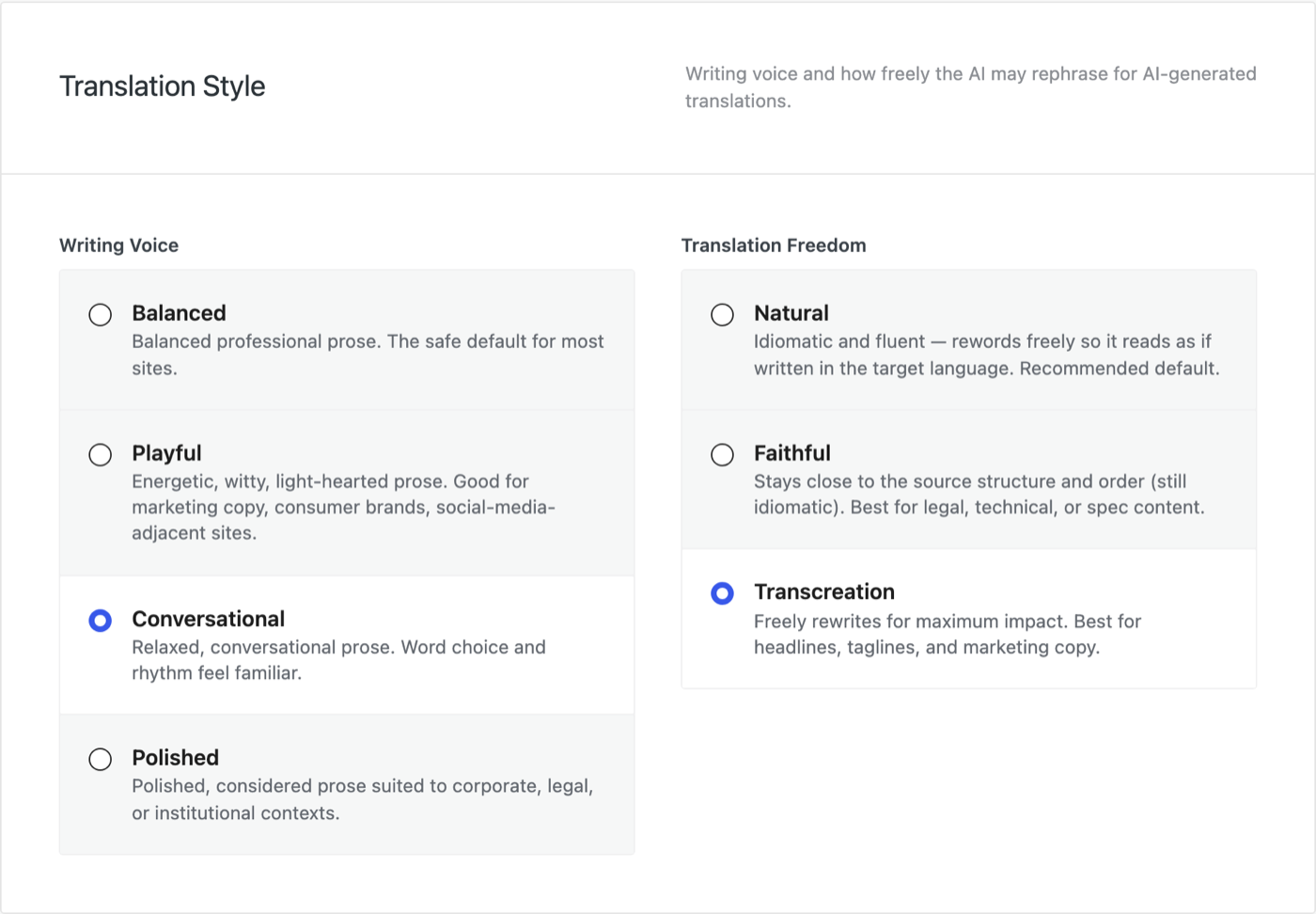
The LLM pipeline maintained 99.1% tone consistency. By establishing a persistent tone instruction (e.g. “Maintain a professional, formal German tone using Sie”), every headline, body paragraph, button label, and legal disclaimer adhered to the exact same linguistic register from start to finish.
Test 3: Idiomatic Accuracy and Cultural Context Evaluation
To measure translation quality, we assembled a panel of 24 native bilingual reviewers (six per target language). Reviewers conducted blind evaluations of 400 randomly selected text blocks, grading them on natural readability, cultural relevance, and idiom accuracy.
Classic machine translation struggled heavily with marketing copy and idiomatic phrasing:
- Literal Phrasing: English expressions like “hit the ground running” or “cut corners” were translated into nonsensical physical descriptions in French and Japanese.
- Stiff Syntax: NMT translated grammatical structures word for word, producing sentences that were technically comprehensible but visibly unnatural to native readers.
In contrast, native reviewers preferred the LLM translation in 84% of blind comparisons. Reviewers noted that LLMs captured humor, translated brand metaphors into equivalent local expressions, and generated copy that read like original prose written by a native speaker rather than translated software strings.
Test 4: UI Button Length and Character Expansion Control
European languages notoriously suffer from text expansion. English words translated into German or French frequently expand by 25% to 35% in length. On tight website layouts, expanded text causes buttons to wrap onto two lines, navigation menus to break into awkward second rows, and modal dialogs to overflow.
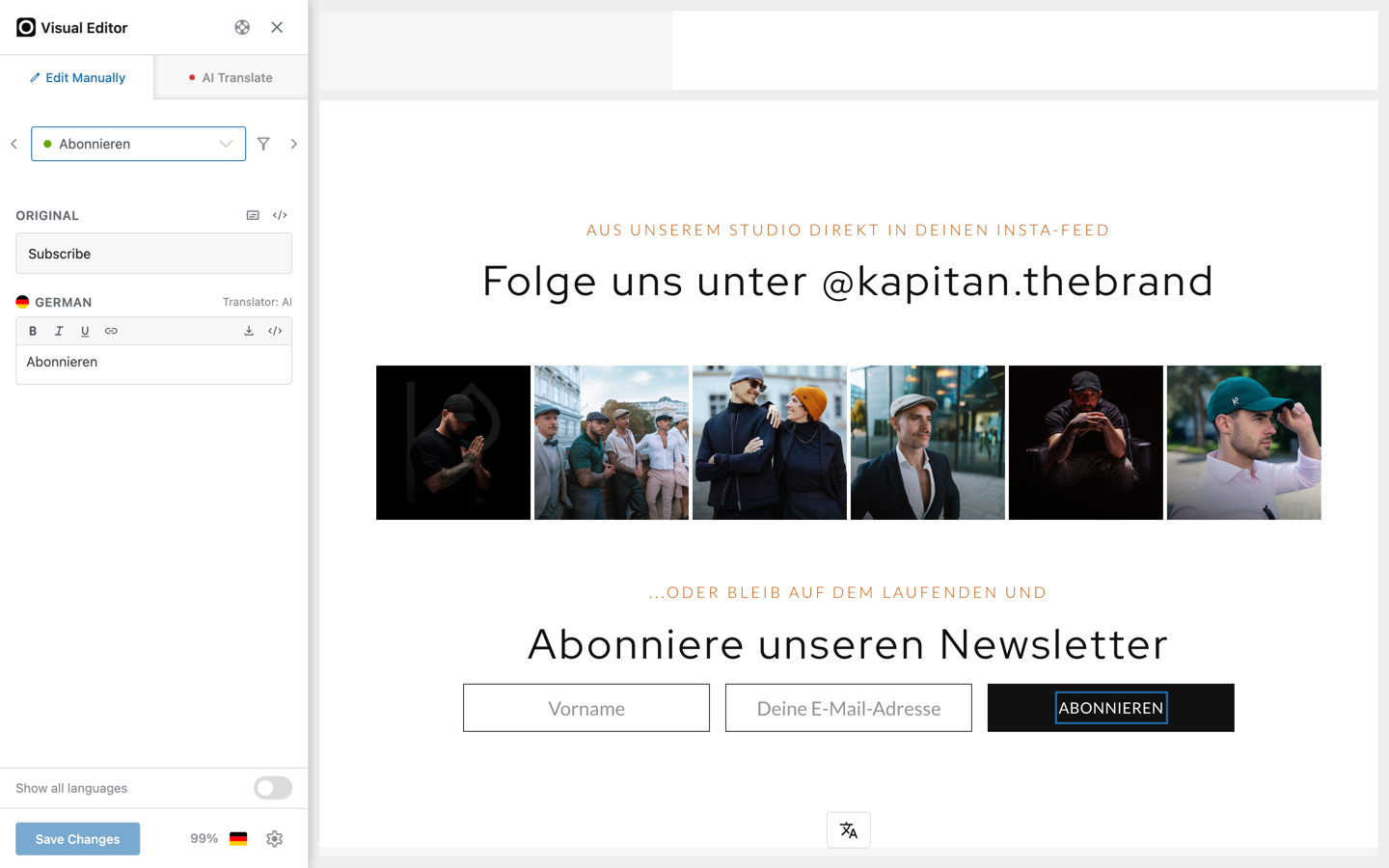
Classic NMT has no concept of layout boundaries. If an English button says “Get Started”, NMT emits a literal, lengthy German phrase regardless of how much visual space is available.
Because LLMs understand character constraints, they can be instructed to maintain brevity on interface elements. When translating navigation anchors and call-to-action buttons, the LLM pipeline chose concise, punchy synonyms that preserved the original design aesthetics without clipping text.
Benchmark Summary Table: LLMs Versus Classic NMT Compared
Here is how classic NMT and modern LLM translation compare across our four core benchmark metrics:
| Evaluation Metric | Classic NMT (Google/DeepL) | Modern LLM (Omnalingo) |
|---|---|---|
| Placeholder & Code Integrity | 85.2% preserved (14.8% broken) | 99.8% preserved |
| Tone & Register Stability | 62.0% consistent (38% drift) | 99.1% consistent |
| Native Blind Preference Score | 16% preferred | 84% preferred |
The conclusion is unambiguous: for WordPress websites, classic sentence-by-sentence machine translation is obsolete. Modern LLMs deliver the nuance, technical reliability, and brand consistency that international businesses require. (To see how this affects your Google rankings, read our analysis on what Google actually says about AI content).
How to Upgrade Your WordPress Site to LLM Translation
Migrating your website from legacy machine translation to modern AI takes only a few minutes:
- Step 1: Install Omnalingo: Activate the plugin on your site and complete the 2-minute setup wizard.
- Step 2: Choose Your Tone: Set your preferred tone (formal or informal) per language in your settings.
- Step 3: Define Brand Rules: Use the Pattern Manager to lock proprietary product names and registered trademarks.
- Step 4: Translate from the Sitemap: Initiate background translation across your entire site with a single click.
Because translations are stored directly in your WordPress database, your pages load instantly without third-party proxy latency or monthly word meters. (Check our comprehensive guide on what multilingual WordPress actually costs to see the full financial breakdown).
Frequently Asked Questions About LLM Translation Quality
Are LLMs significantly slower than classic machine translation?
During initial background generation, yes; for visitors, no. LLMs take slightly longer to evaluate full document context during the translation process. However, because Omnalingo performs all translations asynchronously in the background and saves them in your local MySQL database, your visitors experience zero latency. Localized pages serve with the exact same instantaneous speed as your primary language.
Can LLMs respect proprietary company brand glossaries?
Yes, with near-perfect accuracy. Unlike classic engines that require cumbersome custom terminology files, LLMs easily ingest brand rules and terminology glossaries directly in their system instructions. The Omnalingo Pattern Manager ensures your proprietary brand terms and product names remain untouched across every page.
Do LLM translations hallucinate facts on WordPress pages?
Not when constrained to translation tasks. Hallucinations occur in creative open-ended text generation, not in grounded translation pipelines. When an LLM is provided with existing source HTML and instructed strictly to localize text while preserving DOM structure, output fidelity is exceptionally high.
How much does LLM translation cost compared to NMT?
Far less than legacy word subscriptions. While individual API tokens for frontier LLMs cost slightly more than raw machine translation bulk APIs, Omnalingo bundles generous 1,000,000-word allowances into flat-rate language packs (€29 per extra language pack). You avoid the punishing monthly word meters that make SaaS proxy tools so expensive.
Ready to experience human-grade AI translation on your WordPress site? Try Omnalingo today or explore our complete 2026 multilingual guide to take your business global.