Looking for a quick answer tailored to your specific website? We built an interactive Translation Plugin Cost Comparison Calculator where you can plug in your page volume, target languages, and growth scenarios to see realistic 1-year and 4-year cost projections across all major plugins.
When you shop for a WordPress translation plugin in 2026, you will quickly notice something odd: almost nobody charges for software the way normal WordPress plugins do. Instead of a straightforward license, you are confronted with word-count tiers, confusing token credits, and monthly cloud bills that can easily climb past $1,000 per year. Most of these pricing structures were designed in a pre-AI era, and in our opinion, they are needlessly complicated, outdated, and in some cases, ridiculously overpriced.
For more than fifteen years building WordPress products, we have watched how pricing models evolve. When a technology gets better and cheaper, software should get simpler and more affordable for site owners. Yet in website translation, the opposite happened: companies added meters, word caps, and recurring monthly charges to software that sits on your own server.
We built Omnalingo with a fundamentally different philosophy: we do not believe in charging website owners by the word. This article is an honest, opinionated look at what a multilingual WordPress site actually costs today, how legacy pricing models compare to modern AI architectures, and why we think the industry needs a simpler approach.
A quick note before we dive into the numbers: All pricing figures in this article are based on public pricing pages and our live translation cost calculator. Competitor prices, exchange rates, and packaging tiers are subject to change at any time. We have done our best to capture every plan accurately. If you spot anything that has changed or looks outdated, please let us know through our contact form and we will gladly update it.
The Three Translation Pricing Models in WordPress
Every translation tool on the market today follows one of three distinct pricing philosophies. Understanding the model behind the price tag is the only way to avoid surprise bills as your website grows.
| Model | How It Works | Why It Feels Outdated |
|---|---|---|
| Monthly Cloud Rent | You pay an ongoing monthly fee based on the cumulative words living on your site (e.g. Weglot). | You pay rent every thirty days for static pages you translated years ago. The translations live on the provider’s servers, so if you cancel, your site stops showing them. |
| Credit Packs & Tokens | You buy an annual plugin license, then purchase buckets of translation credits (e.g. WPML, TranslatePress). | Complicated math: word allowances, credit bundles, and top-up packs once your site outgrows what the plan includes. |
| Free Plugin + Flat AI Service | A free plugin, a flat yearly fee for the AI that translates, and a one-time fee per extra language (Omnalingo). | Built for the AI era: simple to calculate, transparent costs, and you own your translations permanently. |
Why Word Meters Feel Like Renting Furniture
The most frustrating trend in WordPress translation is the monthly word subscription. Under this model, a cloud service scans your website and counts every word on every page. You are then placed into a pricing tier based on that total volume.
Think about what that actually means for your business. You write an “About Us” page, a Privacy Policy, or a case study. You translate it once. That text never changes. Yet under a monthly subscription, you continue paying for those exact same words every single month, year after year. It feels like buying furniture for your house, but having to pay monthly rent to the store just to keep sitting on it.
Even worse, if you pause or cancel that subscription, your site stops showing its translations. Because the translated words never lived in your WordPress database, your translated pages and the rankings they earned depend on that payment continuing.
The Credit Confusion: Why Legacy Plugins Make Math So Hard
The second model comes from traditional self-hosted plugins. On the surface, their pricing looks reasonable: you pay an annual fee of $99 or €99 for the plugin license. But automated translation introduces confusing credit and token systems.
For example, one popular plugin includes a fixed number of AI words with its license and sells more on a pay-as-you-go basis. Another sells add-on packs ranging from 100,000 to 10 million words. Why should site owners need a spreadsheet just to figure out what it costs to publish a blog post in French? In an era where AI language models process text at fractions of a cent, metering every word feels like a relic of 2015.
Real Numbers: Comparing 4-Year Costs Across 5 Popular Plugins
To see how these different pricing models compare over time, we ran the numbers through our comparison engine. Let us look at a realistic scenario: an active WordPress site that translates roughly 50,000 words per year across two additional languages (German and Spanish), adding up to 100,000 translated words annually.
Here is what the four-year total cost of ownership looks like when you factor in licenses, renewal fees, and translation volume:
| Plugin | Pricing Structure | 4-Year Average Cost |
|---|---|---|
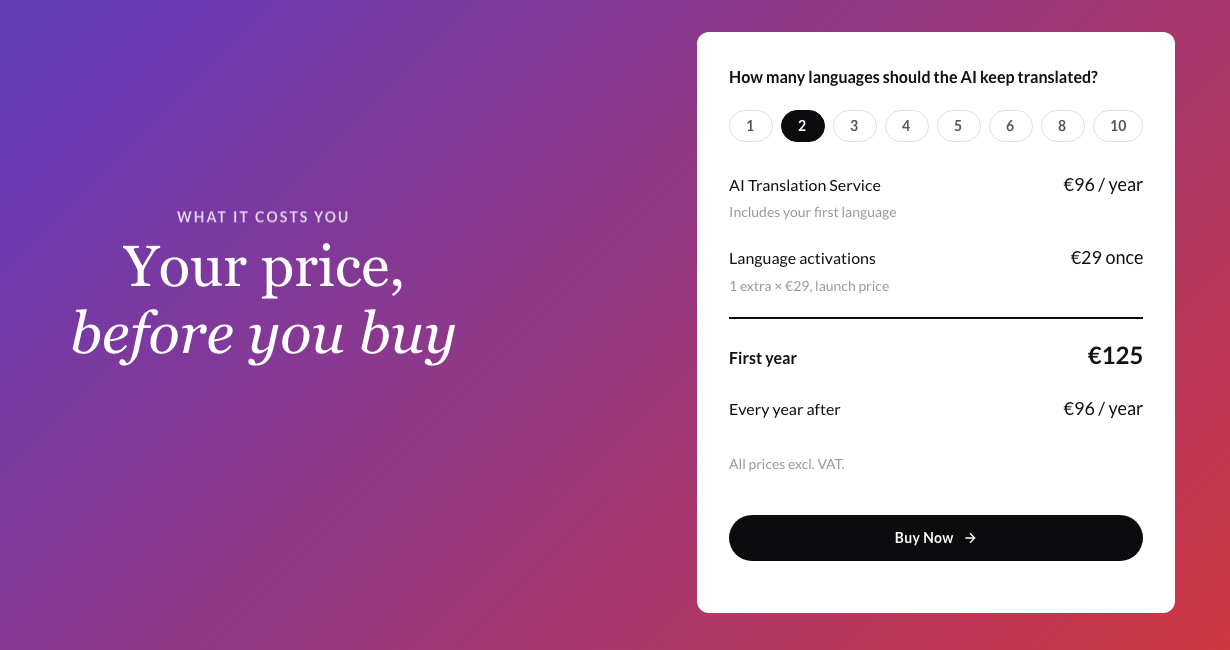
| Omnalingo | Free plugin, €96/yr AI service with 1 language, + €29 once for the second language (launch price) | €103 / year (Total: €413) |
| TranslatePress | €99/yr base + extra AI packs upfront | €179 / year (Total: €715) |
| WPML | €99/yr Multilingual CMS + extra automatic translation words | €231 / year (Total: €924) |
| Polylang + DeepL | €99/yr Pro + your own DeepL API account, billed separately | €99 / year + DeepL usage (Total: €396 + DeepL) |
| Weglot | Subscription scaling with words (Pro plan, annual billing) | €790 / year (Total: €3,160) |
The contrast over a four-year period is dramatic. Over four years, a site owner on a word-based cloud subscription spends more than €3,000 on translation fees alone, while a traditional license with extra AI words lands between roughly €700 and €900. With a modern flat model like Omnalingo, that exact same site costs roughly €103 per year on average.
Why Omnalingo Refuses to Charge by the Word
We took a look at the landscape and decided on a fundamentally different approach. Our core philosophy is simple: we do not believe in charging website owners by the word. Our pricing is built on three clear pillars:
- The plugin is free: Every feature, unlimited languages, unlimited sites. You can run a complete multilingual site and translate by hand without paying anything.
- The AI is one flat fee: If you want the AI to translate for you, the AI Translation Service costs €96 a year (€8 a month, billed annually, excl. VAT) and includes your first AI language. There is no word meter: publishing more does not cost more.
- Extra languages are a one-time purchase: Each further AI language is a one-time €39 (€29 at the current launch price), with no recurring add-on fee. Once you activate German, Spanish, or Japanese, it stays activated.
This model makes budgeting completely predictable. You never have to worry about whether publishing a new case study or adding 50 product variations will push you into a more expensive tier. You know your costs on day one, and they stay predictable.
The WooCommerce Reality: Why Online Stores Get Penalized Most
If you run an online shop using WooCommerce, word counts multiply much faster than on standard marketing websites. A shop with just 200 products rarely has only 200 items of text. Each product has:
- Main descriptions and short excerpts
- Variation attributes (sizes, colors, dimensions, weights)
- Customer review labels and ratings
- Category and brand descriptions
- Checkout notices, cart validation alerts, and shipping messages
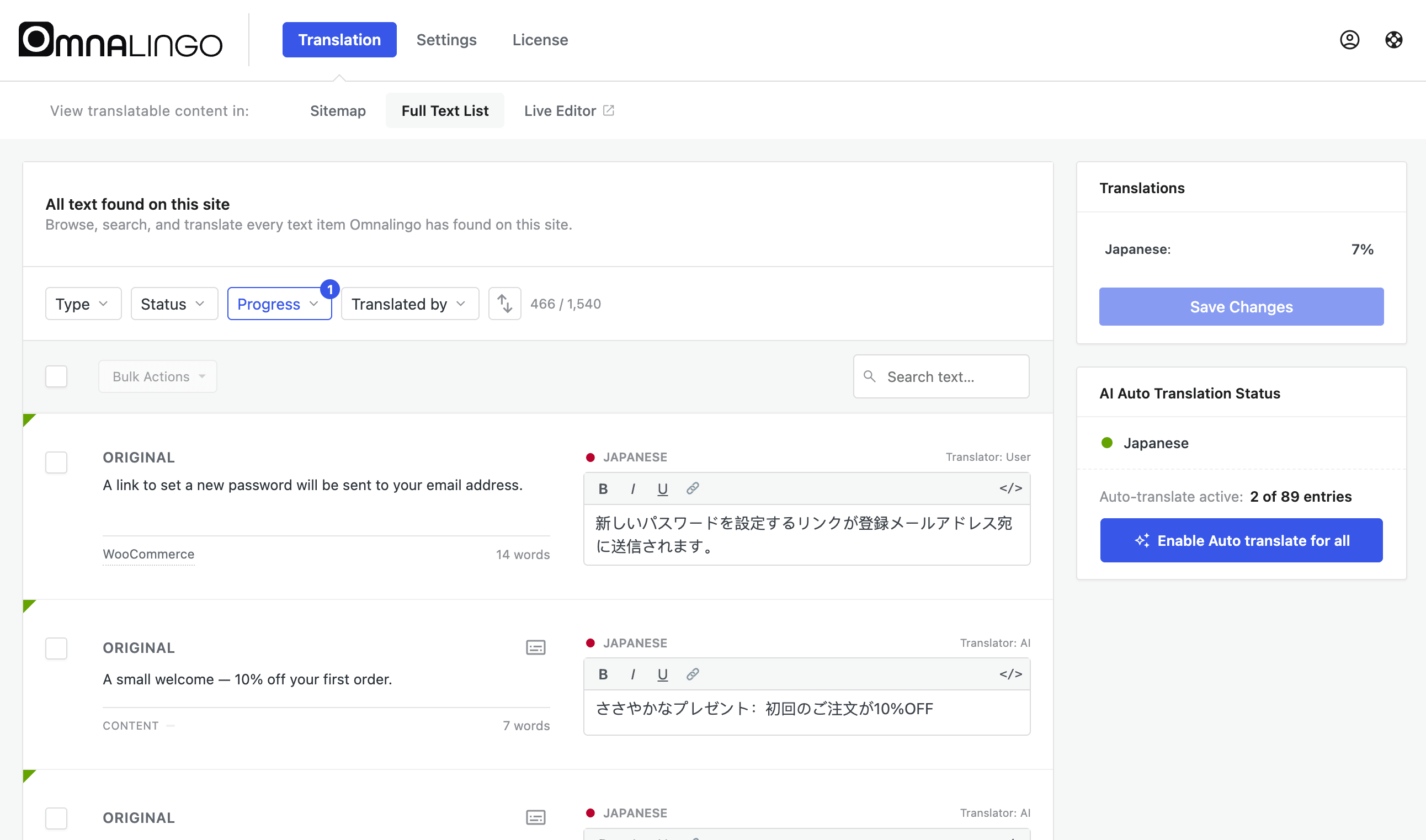
A catalog of 200 products can easily cross 75,000 words. Under a word-based cloud subscription, launching two new languages multiplies that count, and the store quickly lands in one of the higher plans. Adding seasonal products for the holidays can trigger an automatic upgrade that you never budgeted for.
Because Omnalingo stores product translations right inside your WordPress database and charges per language instead of per word, expanding your store never triggers a surprise bill.
A Note on Pricing Accuracy and Updates
We want to emphasize this again: software pricing and packaging tiers are always subject to change. We have done our best to gather accurate, current information from every plugin’s public website, documentation, and pricing calculator. However, companies introduce new tiers, adjust credit allowances, and alter renewal discounts on a regular basis.
If you are an author, developer, or user of any of the plugins mentioned here, and you notice a price, feature tier, or credit allowance that has changed or is no longer accurate, please reach out to us through our contact form. We are committed to keeping our comparison tools completely transparent and will gladly update any figures that have shifted.
Your Practical Multilingual Website Budgeting Checklist
Before choosing a translation plugin or signing up for a monthly service, run through this quick checklist:
- 1. Ask where your words live: Ensure translations are stored directly in your WordPress database so you retain full ownership if you ever change tools.
- 2. Calculate your 4-year total: Never look only at the first-year price tag. Calculate what the tool will cost after 3 or 4 years of publishing content.
- 3. Check for automatic upgrade traps: Find out what happens when your site crosses a word limit. Will your bill increase automatically, or does the tool give you predictable flat rates?
- 4. Check language expansion fees: Verify what it costs to add a second or third language down the road.
- 5. Avoid proprietary credit math: Choose solutions with transparent language pricing over complex credit tokens and artificial character limits.
Frequently Asked Questions About Translation Costs
Are competitor prices and plans guaranteed to be exact?
As noted earlier, competitor prices and plan features are subject to change at any time. We calculate these estimates using publicly listed rates and standard fair-use tiers, but plugins frequently revise their packages. If you notice any outdated numbers, please let us know through our contact form.
Why Are Extra Omnalingo Languages One-Time Purchases?
Because once you translate your core site, the hardest work is done. You do not need to pay rent just to keep serving pages that were already translated. A one-time €39 per extra AI language (€29 at the launch price) covers that language, and the yearly AI Translation Service keeps all your activated languages translated as you publish.
Is There Really No Word Limit?
For normal websites, no. To prevent abuse, each activated language has a fair-use ceiling of 1,000,000 AI words per year. That is roughly the length of Shakespeare’s complete works, every year, in every language, and almost no website ever comes close. If yours genuinely does, get in touch and we will find a solution.
Tired of word-counting spreadsheets and monthly translation bills? See how Omnalingo brings simple, predictable pricing and full database ownership to multilingual WordPress.